
Fouls - Law 12
Making Foul Decisions - Direct Free Kicks (DFKs)
As Referees do we take into account if the player meant to commit the foul, or any other action?
- NO WE DO NOT - As referees we only judge the action. If a defender trips an attacker then we call a foul. We don’t judge intent.
Use the process laid out below to help make basic foul decisions. This will guide you in creating your own process to decide if the contact you see in your games is a foul or is not a foul.
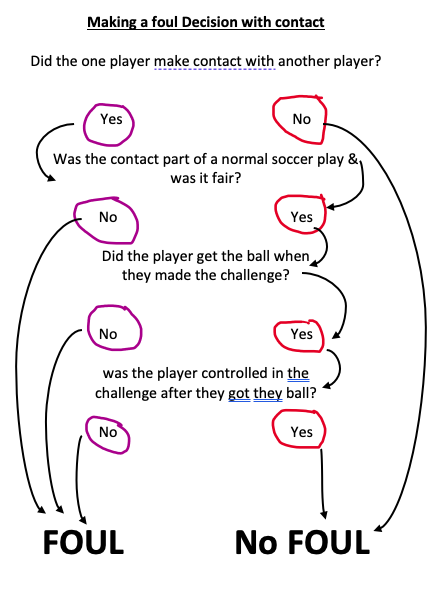
When making decisions about challenges with contact we first need to see if there is any contact. Contact is soccer and that is the first step in deciding if there is a contact foul.
No Contact - Then we can go directly to NO FOUL and out decision has been made.
YES Contact - Then we have another questions to as ourselves
Was the contact part of normal soccer play? As we said above, contact is part of soccer but it must be fair contact. As referees we must decide if that was fair soccer contact or if it was not fair and not part of soccer.
NO - Then we can go straight to FOUL - blow your whittles and call the foul
If we can answer Yes Then go to our next question to ask ourselves
Did the player get the ball when they made the challenge? If you don’t get the ball when trying to kick the ball and accidentally kick the player then it is a foul. Getting the ball is important.
NO - Then we can go straight to FOUL - blow your whittles and call the foul
If we can answer Yes Then go to our next question to ask ourselves
Was the player controlled in the challenge after they got the ball? Just because you get the ball does not give you permission to be dangerous or out of control.
NO - Then we can go straight to FOUL - blow your whittles and call the foul
Yes - Then this is not a foul - allow play to continue